
Many guests form an opinion of a hotel before anyone has said a word to them. They notice whether the person at the desk looks up, whether the porter’s shoulders are relaxed and whether the restaurant host seems pleased to see them. For frontline staff, non-verbal communication in hospitality is not a soft extra. It is the part of service that guests read first, and often the part they remember longest. This guide covers what works, what undermines a good interaction, and how to build these habits into a team’s daily routine.
Table of Contents
- Quick Takeaways
- Why First Impressions Form Before the Greeting
- Posture and Movement at the Front Desk
- Eye Contact and Attention Signals
- Facial Expressions and the Genuine Smile
- Hand Gestures and Avoiding Distracting Movements
- Handling Body Language During Complaints
- Training Non-Verbal Skills in Your Team
- Frequently Asked Questions
- References
Quick Takeaways
| Key Insight | Explanation |
|---|---|
| Look up and make eye contact before you speak | At check-in, the guest judges your attention in the first few seconds. Finish typing, look up, then greet them. |
| Face the guest squarely | Turning your shoulders towards a screen or a colleague signals that you are busy with something else. |
| Keep hands visible and still | Hands in pockets or arms folded across the chest read as guarded, especially during a complaint. |
| Nod occasionally while a guest talks | Slow, occasional nods show you are listening. Rapid, constant nodding looks automatic. |
| Use a full smile, not a mouth-only smile | A genuine smile changes the eyes as well as the mouth. A forced one often reads as insincere. |
| Slow your pace and lower your voice when a guest is upset | Guests often mirror the calm they see. A faster, louder response usually raises the temperature. |
| Practise with recorded role play | Watching yourself back reveals habits you cannot feel while you are doing them. |
Why First Impressions Form Before the Greeting
Guests walk into a hotel lobby and start reading the room straight away. They are checking whether staff look settled, whether anyone seems to be watching them and whether the space feels welcoming. Most of that judgement is formed without conscious thought.
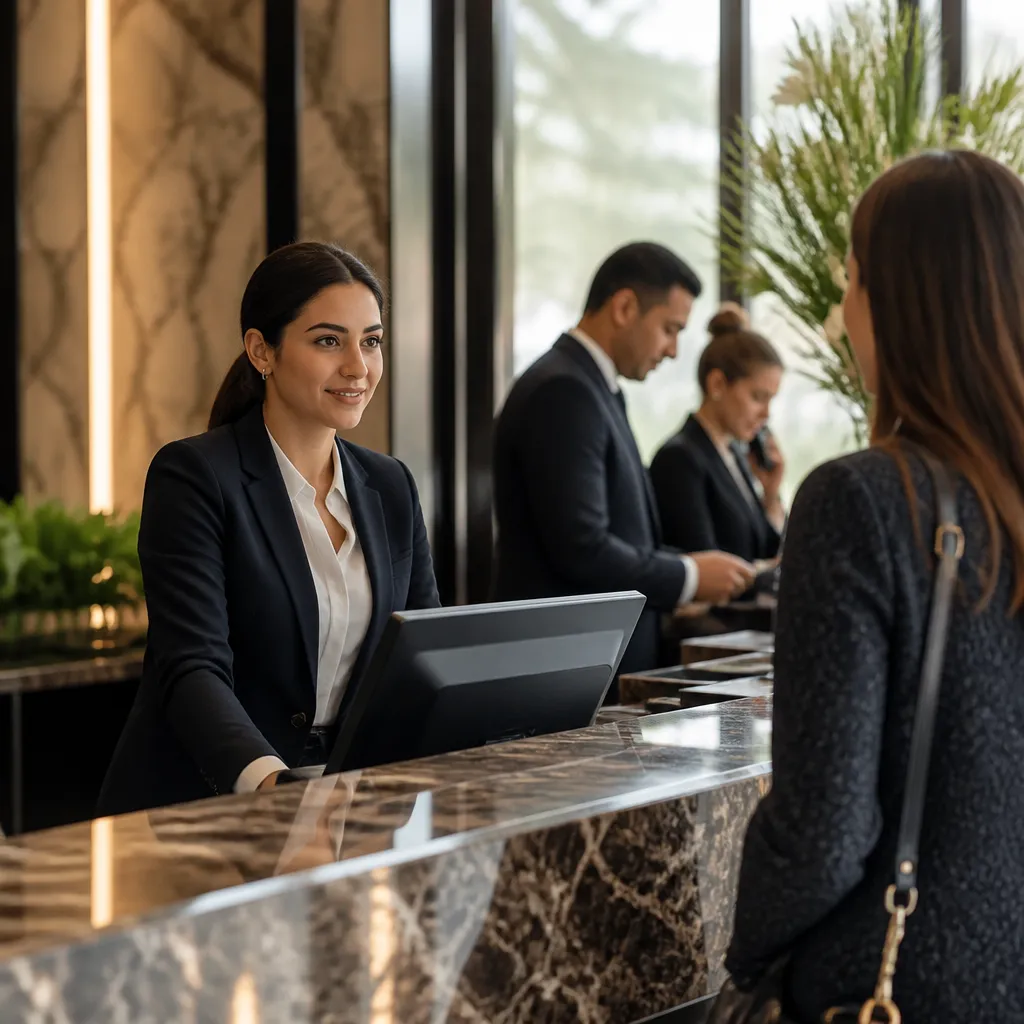
Non-verbal cues arrive faster than speech. A guest can judge a desk agent’s attitude from the way the agent lifts their head as the door opens, and that first read shapes how they hear everything said afterwards. A warm greeting delivered with folded arms or a fixed stare often lands as a contradiction, and guests tend to trust the body over the script.
The Two-Second Window at Reception
At the desk, the opening moments carry the most weight. Look up, make eye contact and offer a small smile before you start reaching for the key cards or the register. A common mistake is finishing a task on the screen and then greeting the guest with your head still angled down.
Why Guests Read Tone and Posture Together
Guests do not separate words from posture. A cheerful ‘good afternoon’ said while leaning on the counter sounds more dismissive than the same words spoken from an upright position. Train staff to check both at once, rather than treating the script as the whole job.
Pro tip: Ask a colleague to watch your first three seconds at the desk for one full shift. Most people discover habits they never noticed, such as glancing away before speaking or hovering their hand over the keyboard.
Posture and Movement at the Front Desk
Posture tells guests whether you are available to help. Standing upright, with your weight spread evenly over both feet, suggests readiness. Slumping onto one hip or leaning on a monitor suggests the opposite, even when you are working hard.
Standing Position Behind the Counter
Stand slightly forward of the desk edge rather than tucked behind a computer. This keeps your torso visible and open, and it makes it easier to step around the counter for a guest who needs help with luggage or a wheelchair. Avoid resting both forearms on the counter for long periods, which can look as though you are blocking the guest out.
Walking Pace in Public Areas
In a busy lobby, staff often move quickly, and that pace can unsettle guests who are unsure where to go. A purposeful but unhurried walk signals competence. If you must cross the lobby quickly, slow down as you pass a guest and glance towards them before you speak.
Movement also matters when you are guiding someone. A short walk to the lift or the breakfast room gives you a chance to show care, but only if your pace matches theirs. Guests who are rushing past you on the way out tend to notice when staff appear to be walking at a different tempo from them.
Pro tip: When you walk a guest to a lift or a restaurant, move about half a step ahead and turn your head back to check they are following. It keeps them included without making them feel hurried.
Eye Contact and Attention Signals
Eye contact is the clearest signal that a guest has your attention. Held steadily, it reads as respect. Held too long without a break, it can feel intense, and the guest may look away first.
Holding Eye Contact During Check-In
During check-in, glance at the screen to confirm details, then return your gaze to the guest when you speak or ask a question. Looking up between each step keeps the exchange personal. Guests often notice when staff look at them only to hand over the key card.
Nodding While a Guest Speaks
A few small nods show you are following what is being said. Published customer service guidance, including the career advice linked in the references, lists nodding to show understanding among the basic habits of good body language. It is one of the easiest skills to practise because it requires no extra time.
Keep nods slow and occasional. Constant rapid nodding looks automatic, and some guests read it as a sign that you are waiting for them to finish so you can move on.
Guests rarely remember the exact words a team member used. They remember whether that person looked as though they were listening.
Facial Expressions and the Genuine Smile
A smile is the most common signal in hospitality and also the most misused. Guests can usually tell when a smile sits only in the mouth. A full smile lifts the cheeks and creates slight creases around the eyes, which is why it reads as warmth rather than routine.

Telling a Real Smile From a Forced One
Practise in a mirror and check whether your eyes change along with your mouth. A forced smile tends to hold still while the face around it does not. Staff who smile through a long, stressful shift often look tense even when they are smiling, so take short breaks where you can let your face return to neutral.
Resting Face During Busy Periods
A neutral expression is not a problem in itself. A calm, relaxed face is better than a fixed grin held while a guest waits in a queue. Guests can read a tired face as disinterest, so the fix is to acknowledge people quickly with a brief look and a nod, even when you cannot serve them immediately.
Pro tip: When you cannot help a guest straight away, make eye contact, say ‘I will be with you in a moment’ and keep your hands visible. The wait feels shorter when the guest knows they have been seen.
Hand Gestures and Avoiding Distracting Movements
Hands carry much of the meaning in service. Open palms, relaxed fingers and purposeful movements build trust, while fidgeting, pointing and tapping distract guests from what you are saying. Practical guidance on non-verbal communication in customer service, linked in the references, advises staff to control their gestures and avoid sudden movements, which is a sensible starting point for most teams.
Directing Guests With an Open Hand
Pointing with a single finger can feel abrupt, particularly when you are directing a guest towards the lifts or the restaurant. Turn your palm upwards and sweep your arm gently in the right direction. The guest feels guided rather than told.
Crossed Arms, Pockets and Hair Touching
Some habits are invisible to the person doing them. Crossed arms, hands in pockets and touching the face or hair can all read as guarded or bored. Hotel staff often stand for long shifts, and teams slip into these positions without thinking. A short self-check at the start of each shift helps more than a general reminder to ‘look professional’.
Be especially careful during handovers and when a colleague is serving a guest nearby. Turning your back on the interaction, even briefly, can signal that you are not part of the service in progress.
Handling Body Language During Complaints
Body language matters most when things go wrong. A guest who has been waiting for a room, a hot meal or a corrected bill is already tense, and the way staff move and speak can either settle the situation or escalate it.
Slowing Down and Lowering Your Voice
When a guest raises their voice, the instinct is to speak faster and more firmly. That usually escalates the exchange. Slow your movements, lower your volume slightly and keep your posture open. Guests often mirror the calm they see, so a relaxed body can bring the temperature down before you have solved the problem.
Standing at the Guest’s Level
Where possible, come out from behind the desk or move to the same side of the table. Standing face to face across a barrier can feel confrontational. Standing at a similar height, with a clear line of sight, shows you are working on the problem alongside the guest.
Adjusting for Cultural Differences
Eye contact, personal space and gestures carry different meanings across cultures. Some guests see direct eye contact as respectful, while others find it challenging. Rather than applying one rule to everyone, watch how each guest responds and follow their lead while keeping your own standards of courtesy.
Pro tip: Once a complaint is resolved, check your body language for the next few seconds. Guests often judge the end of an interaction by how staff look as they turn away.
Training Non-Verbal Skills in Your Team
Body language is hard to teach from a slide deck. Most people learn it by seeing themselves in action or by receiving honest feedback from someone who watched them work. For supervisors, the aim is to build short, repeatable practice into the week rather than running a single workshop and hoping it sticks.
| Approach | What It Develops | Best Used When |
|---|---|---|
| Mirror practice at the front desk | Facial expression and posture awareness | New starters are learning their desk routine |
| Peer observation with a checklist | Eye contact, gestures and attention cues | The team needs consistent standards across shifts |
| Recorded role play reviewed with a supervisor | Overall presence and tone under pressure | Staff are preparing to handle complaints |
Running a Peer Observation Round
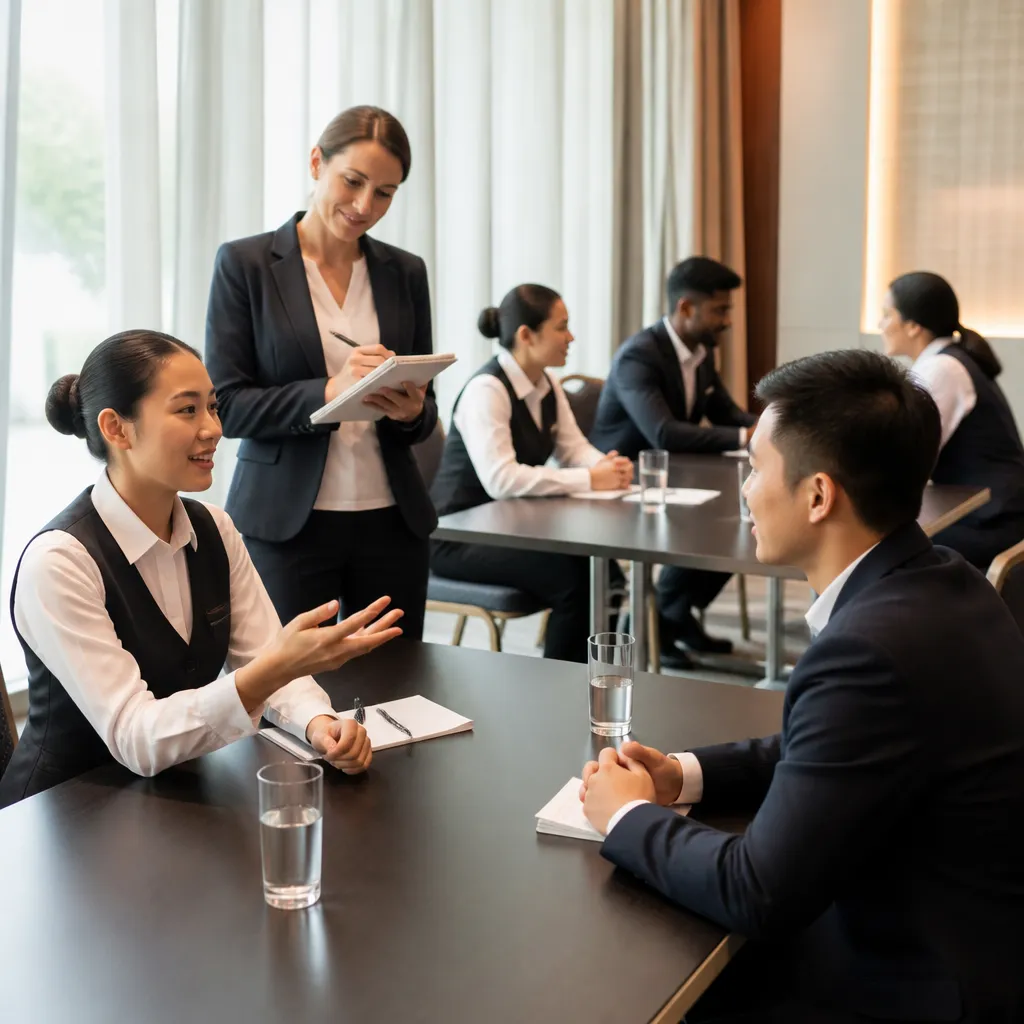
Pair two team members, give each a checklist of three or four behaviours and rotate roles so that both people observe and are observed. Keep feedback specific. ‘You nodded twice when the guest explained their booking’ is far more useful than ‘you seemed friendly’. Specific observations are easier to act on and less likely to feel personal.
Using Role Play Without Making It Awkward
Recording role play can feel uncomfortable, so keep clips short and agree in advance that they are for development only. Review one behaviour per clip. Staff tend to improve faster when they focus on a single change at a time, such as keeping their hands visible during check-in.
Global Hospitality Institute offers online training for people at every stage of their hospitality career, and you can explore the wider range of guest experience resources on the Global Hospitality Institute website.
Frequently Asked Questions
How is non-verbal communication in hospitality different from body language?
Body language is one part of non-verbal communication. Non-verbal communication also includes tone of voice, timing, the distance you keep from a guest and how quickly you respond. In hotel service these signals work together, so training should cover them as a set.
What is the most important body language habit for frontline hotel staff?
Eye contact combined with a brief, genuine smile at the start of an interaction is the habit that makes the most difference. It signals attention and welcome within seconds, before any words are spoken. Keep it consistent across the shift rather than saving it for quiet moments.
Can improving body language help my career progress?
Consistent, confident guest service is something supervisors notice, and it forms part of a wider professional record. However, no course can guarantee employment or promotion. Treat these skills as one part of your development, alongside operational knowledge and practical experience.
How can I practise body language if I cannot get peer feedback?
Record short clips of yourself greeting an imaginary guest, then watch them with the sound off so you can focus only on your posture, hands and face. Repeat the exercise with sound on and compare the two. Doing this once a week makes changes easier to spot.
Is GHI Certification the same as a Udemy course completion certificate?
No. A Udemy course completion certificate shows that you finished the course. GHI Certification is a separate step that learners can apply for after completing Hospitality Foundations and achieving at least 80% in the Final Assessment.
Build practical, industry-relevant skills with Hospitality Foundations, the online training programme from Global Hospitality Institute. Learn at your own pace and take the next step in your hospitality career.
Which non-verbal habit has made the biggest difference in your own guest interactions, and what did you change to get there?