
Ask a guest what went wrong on their stay and they will rarely name a department. They will say the room was not ready, the breakfast order went missing, or nobody answered the phone about a broken shower. Behind each of those moments sits a handoff between teams that were supposed to work together. This hotel departments overview explains how the main departments are structured, what each one owns, and where the handoffs usually break. If you are starting out in hospitality or moving into a supervisory role, understanding this map will make everything else you learn about hotel operations easier to place.
Table of Contents
- Quick Takeaways
- Front Office and Housekeeping
- Food and Beverage and the Kitchen
- Maintenance, Engineering and Security
- Sales, Marketing and Revenue
- How Departments Work Together in Practice
- Hotel Organisational Structure
- Common Operational Failures and How to Prevent Them
- Frequently Asked Questions
- References
Quick Takeaways
| Key Insight | Explanation |
|---|---|
| Room status is a shared fact | A room marked clean in the property management system should be sellable immediately. Front office should never have to ask housekeeping whether a room is ready. |
| Flag rooms that are nearly ready | Front office can plan an early arrival around a room that will be ready in twenty minutes. It cannot plan around a room that nobody mentioned. |
| Out-of-order rooms need three details | Engineering should record the reason, the expected return date and the time the fault was found, so reservations can stop selling the room the same hour. |
| Banquet orders reach the kitchen first | The final event order should go to the kitchen and stewarding before the room is set, not after the client changes the menu. |
| Sales checks operations before signing groups | Confirm room availability, housekeeping turnover and food and beverage capacity before any group contract is signed. |
| Every handoff needs a named owner | A message addressed to “the desk” or “the kitchen” tends to be read by nobody. Name the person responsible for each open issue. |
Front Office and Housekeeping
The front office is the operational hub of most hotels, but it is also the team that absorbs the blame when problems start somewhere else. Front office agents sell rooms, handle arrivals and departures, and answer questions that come from every other department. Some guides count eight major departments in a typical hotel, while others list twelve once they separate smaller teams. The number matters less than the principle: each department owns a set of decisions, and the front office needs to know what those decisions are.

Room status as the shared source of truth
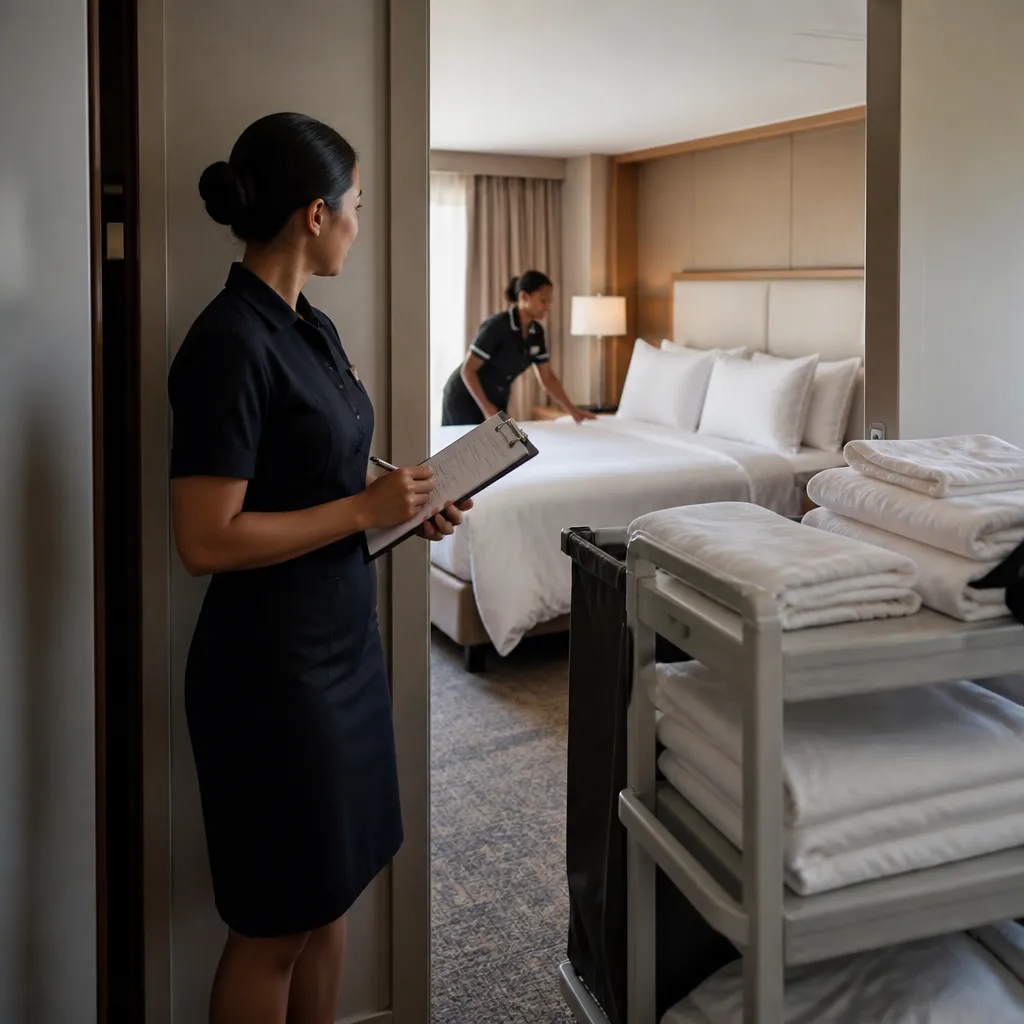
Room status is where front office and housekeeping meet most often. A room marked checked out but not yet cleaned cannot be sold, and a room marked clean when it still has a maintenance fault will send an arriving guest to an unhappy check-in. In practice, the housekeeper’s update in the property management system should be treated as a live fact, not a note to be checked later. If an inspector finds a stain or a faulty lock, the desk needs to hear about it before the next guest is assigned.
Good room status depends on room readiness being visible to everyone who sells or assigns rooms. It also depends on housekeeping understanding that an unrecorded clean is, for front office, the same as a dirty room.
Early arrivals and the cost of waiting
A common failure is the early arrival. A guest asks to check in at 11am, the desk assigns a room that housekeeping has not yet reached, and the agent has no way of knowing. Close coordination between front desk and housekeeping prevents exactly this kind of wait, because rooms are prepared in the order that arrivals need them. A published guide from a hotel software provider makes the same point about reducing wait times through coordination.
Pro tip: Ask housekeeping to flag rooms that are nearly ready, not only rooms that are finished. Front office can plan an early arrival around a room that will be ready shortly, but not around one that nobody has mentioned.
Food and Beverage and the Kitchen
Food and beverage is one of the busiest areas in most hotels and the one guests judge most quickly. It usually covers the restaurant, bar, room service and banqueting, with the kitchen as the production centre behind them. The kitchen and the restaurant run on different clocks. The kitchen plans around covers and prep lists, while the restaurant plans around service times and table turns, and the two only stay in step when someone is responsible for linking them.
Banquets and events, where timings break
Banqueting is where cross-department cooperation is tested hardest. The events team, the kitchen, stewarding, front office and sometimes engineering all need the same run sheet. A typical failure looks like this: the client adds a course on the afternoon of the event, the change reaches the restaurant but not the kitchen, and the stewards set the tables for a menu that no longer exists. Keep one banquet event order as the master document, and make every department sign off on its own section.
Stock, par levels and the function forecast
Food and beverage also depends on the storeroom and receiving teams, and that dependency is easy to overlook. A bar that runs out of a standard spirit during a wedding reception is a stock problem, but the guest will experience it as a service failure. Set par levels with the banqueting diary in view, and share the weekly function forecast with purchasing so that deliveries arrive before the event, not on the day. Across hotel operations departments, this kind of last-minute request is one of the most frequent sources of friction between F&B and the rest of the building.
Maintenance, Engineering and Security
The maintenance and engineering team keeps the building running, and it is the department guests notice least until something stops working. Indeed’s guide to hotel departments describes the maintenance and operations department as the team that manages the building and property, dealing with issues such as plumbing. In a hotel, a dripping tap is never just a repair. It is also a decision about whether the room can be sold that evening.
Out-of-order rooms and the sales calendar
An out-of-order room needs a clear reason, an expected return date and a status that front office can see. Without those three things, the reservations team will keep selling a room that engineering already knows is unavailable. The fix is simple. Engineering logs the fault in the maintenance system when it is found, and front office receives a notification the same hour, so the room can be blocked and any affected bookings moved.
Security and the night handover
Security sits in an awkward place on the organisational chart. Some properties run it in house, others contract it out, and either way the night team needs a clear route into front office and management. A noise complaint, a suspicious visitor or a lost key should follow a defined path. The duty manager should hear about it from the security log, not from a guest at 7am.
Sales, Marketing and Revenue
Sales and revenue teams decide what the hotel promises before anyone in operations has seen the booking. That is normal, but it becomes a problem when a sales manager accepts a block of forty rooms for a date when housekeeping is short, or agrees a conference lunch for a restaurant that has no spare capacity. Sales sells the inventory. Operations determines whether the hotel can deliver it.
Group bookings that need operational sign-off
Before a group contract is signed, the sales manager should check three things with the relevant department heads. Those are room availability with front office, housekeeping capacity for the room turnover, and food and beverage capacity for meals. This check takes a short conversation rather than a formal meeting. Hotels that skip it often discover the problem on arrival day, when there is little room left to fix it.
Group sign-off should be recorded on the booking, so that whoever handles the contract later can see who confirmed what.
Rate changes and the staffing roster
Revenue managers price rooms according to availability, but they rarely see the housekeeping schedule. A late rate change that fills the last rooms on a day when two housekeepers are off sick creates a hidden risk. Sharing the staffing roster with the revenue meeting helps both sides see the real constraint. It also stops the hotel from selling its way into a day it cannot staff.
How Departments Work Together in Practice
Departments do not coordinate because an organisation chart says they should. They coordinate because someone sets up a rhythm and the rhythm survives busy days. The three mechanisms that appear most often are a daily briefing, a shared system for room status and a written handover log. Each solves a different problem, and each fails in a predictable way.
The daily briefing that changes decisions
A morning briefing works when it covers arrivals, departures, VIP guests, out-of-order rooms and the day’s events, and nothing else. It fails when it turns into a status report that everyone endures. Keep it short, invite the duty manager from each department, and finish with a named owner for every open issue. If a point does not change what someone does today, leave it out.
Handovers between shifts
Hotels run around the clock, and most operational problems happen in the gap between shifts. A written handover log that records open requests, pending repairs and guests with special needs is the simplest tool for closing that gap. The rule that matters is that the incoming manager reads the log before the first walk-round, not after the first complaint.
| Coordination method | Best used for | Main risk |
|---|---|---|
| Daily briefing | Arrivals, VIP guests, out-of-order rooms and the day’s events | Becomes a ritual that misses live changes made after the meeting |
| Shared room status in the property management system | Real-time room readiness for front office and housekeeping | Only as accurate as the last person who updated it |
| Written handover log | Open requests, pending repairs and shift-to-shift follow-up | Ignored if the incoming manager does not read it at the start of the shift |
None of these methods replaces the others. A briefing sets the day, the room status keeps sales accurate minute by minute, and the handover log carries the unfinished work across the night.
A department that is never told is a department working from the wrong information, however hard its team tries.
Pro tip: Ask each department head to name the one piece of information the next department always needs from them. Write those answers on the briefing sheet. It turns a vague meeting into a checklist of handoffs.
Hotel Organisational Structure
The hotel organisational structure determines who makes decisions, who can override whom and who gets called at 2am. Most hotels group their teams into rooms operations and food and beverage, supported by functions such as finance, human resources, sales and engineering. Larger properties often add a layer of department heads reporting to a general manager, while smaller ones combine roles so that one person covers several areas.
Core and support departments
The distinction between core and support departments is useful when you are deciding priorities. Core departments such as rooms and food and beverage deal directly with guests, while support departments such as human resources, finance and engineering keep the property working. Support teams often lose attention during busy periods, which is exactly when the building needs them most. A supervisor who understands both groups will know which requests can wait and which cannot.
Reporting lines and who decides
Clear reporting lines matter more in hotels than in many offices because decisions are needed at all hours. A night duty manager should know which decisions they can make without waking the general manager, such as relocating a guest or approving a small repair. Writing that down in a short authority matrix saves more time than most ad hoc instructions. Hospitality Foundations, our online programme, covers how these structures work in day-to-day practice, you can find details here.
Common Operational Failures and How to Prevent Them
Most cross-department problems follow a small number of patterns. They are rarely dramatic. They are usually a message sent to the wrong person, a status that was not updated, or a decision made by one team and assumed by another. Knowing the patterns helps you spot them in your own property before a guest does.

The message sent to the wrong person
A housekeeper reports a broken lamp to the front desk, the desk assumes engineering has been told, and engineering never hears about it. The fix is to assign a destination for each type of issue and write it into the handover sheet or the system. Maintenance goes to engineering, guest requests go to the duty manager, and no issue is passed on by default.
Status updated too late
A room cleaned at 10am but marked clean at 3pm is a room the front desk could not sell for five hours. Ask housekeeping to update status at the moment the task is finished, and have front office check the room board at set points during the day. Late updates are a frequent cause of arrival-day surprises, and they are among the easiest to fix.
Decisions made without the affected team
A general manager approves a late checkout for a corporate guest without asking housekeeping whether the room can be held. The guest is happy, and the next arrival waits in the lobby. Any decision that touches another department should record the name of the person who was consulted, even if the check takes thirty seconds.
Frequently Asked Questions
What are the main departments in a hotel?
Most hotels include front office, housekeeping, food and beverage, kitchen, maintenance and engineering, sales and revenue, and human resources, with finance and security often added depending on the property. Guides differ on how many departments they count, mainly because some split smaller teams into their own categories.
Which hotel department should a beginner learn first?
Front office is a strong starting point because it touches almost every other department. Working the desk teaches you room status, guest requests and the flow of information, which makes the work of other departments easier to understand.
What is the difference between core and support departments?
Core departments deal directly with guests, such as rooms and food and beverage. Support departments, such as engineering, finance and human resources, keep the property running and rarely appear in the guest’s experience unless something goes wrong.
Does completing a Hospitality Foundations course give me GHI Certification?
Completing the course on Udemy gives you a Udemy completion certificate, which is not the same as GHI Certification. To apply for GHI Certification, you need to complete the programme and achieve at least 80% in the Final Assessment. Certification supports your learning and CV, but it does not guarantee employment or promotion.
How can hotels stop departments working in silos?
Start with a short daily briefing, a shared room status system and a written handover log, then assign a named owner to every open issue. Silos usually form when information is passed informally, so the most effective change is to make key handoffs visible and routine.
Build practical, industry-relevant skills with Hospitality Foundations, the online training programme from Global Hospitality Institute. Learn at your own pace and take the next step in your hospitality career.
Tell us about a handoff between departments that worked well at your property, or one that failed, and what you did to fix it.